
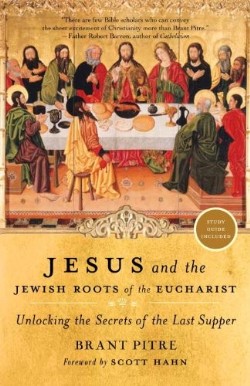
Jesus And The Jewish Roots Of The Eucharist
In recent years, Christians everywhere are rediscovering the Jewish roots of their faith. Every year at Easter time, many believers now celebrate Passover meals (known as Seders) seeking to understand exactly what happened at Jesus’ final Passover, the night before he was crucified.
Jesus and the Jewish Roots of the Eucharist shines fresh light on the Last Supper by looking at it through Jewish eyes. Using his in-depth knowledge of the Bible and ancient Judaism, Dr. Brant Pitre answers questions such as: What was the Passover like at the time of Jesus? What were the Jewish hopes for the Messiah? What was Jesus’ purpose in instituting the Eucharist during the feast of Passover? And, most important of all, what did Jesus mean when he said, “This is my body… This is my blood”?To answer these questions, Pitre explores ancient Jewish beliefs about the Passover of the Messiah, the miraculous Manna from heaven, and the mysterious Bread of the Presence. As he shows, these three keys-the Passover, the Manna, and the Bread of the Presence-have the power to unlock the original meaning of the Eucharistic words of Jesus. Along the way, Pitre also explains how Jesus united the Last Supper to his death on Good Friday and his Resurrection on Easter Sunday.
Inspiring and informative, Jesus and the Jewish Roots of the Eucharist is a groundbreaking work that is sure to illuminate one of the greatest mysteries of the Christian faith: the mystery of Jesus’ presence in “the breaking of the bread.”
SKU (ISBN): 9780385531863
ISBN10: 0385531869
Binding: Trade Paper
Published: February 2016
Publisher: WaterBrook
Related products
-
Essential Catholic Handbook (Revised)
Read moreThis invaluable book for those who want a topical summary of “what it means to be Catholic,” is now even more useful. This expanded edition includes a new Introduction, the current list of holy days of obligation observed in the United States, the Prayer for Vocations preferred by Pope John Paul II, a new section on how to prepare for a sick call, an index, and much more.
An important reference work for any interested Catholic, especially those involved in church ministry.Includes a glossary of key terms and cross-referenced to the Catechism of the Catholic Church.
-
Perseverance In Trials
Read moreChristian life, like life generally, is marked by trials. For this reason, the author has chosen the Book of Job as a primary text for reflection, although other passages of the Old and New Testaments are also offered for meditation.
The story of Job spoke to the Jewish people exiled in Babylonia, even as it speaks to us today. It inspires questions such as, Does suffering have meaning? Can human beings ask God to account for that suffering? It counters those questions by asking for belief in God’s ultimate justice and (humanly) incomprehensible wisdom.
In comments marked by spiritual and pastoral depth, Cardinal Martini, Archbishop of Milan, dwells on certain passages of Job that help shed light on the meaning of the mystery of the human person and the mystery of God. The reflections are gathered from retreat lectures given by the cardinal. When read in an atmosphere of prayer, these pages become a source of light, nourishment, strength, incentive, and consolation.
-

Courage Of Faith
Read moreLiving a courageous life is not easy. It requires a person to find the balance between fearlessness and cowardice. In The Courage of Faith Steven Ostovich encourages readers to wrestle with their questions of belief in order to find a way to choose faith. He shows that belief, promise, hope, love, responsibility, and thinking demand courage. Ostovich helps readers to reflect on their understandings of these topics by using the writings of philosophers from Plato to Hannah Arendt, Rene Descartes to Simone de Beauvoir. By engaging philosophy, theology, and the Bible, he challenges readers to courageously think from and through faith. The result of such thinking is a commitment to belief.
-
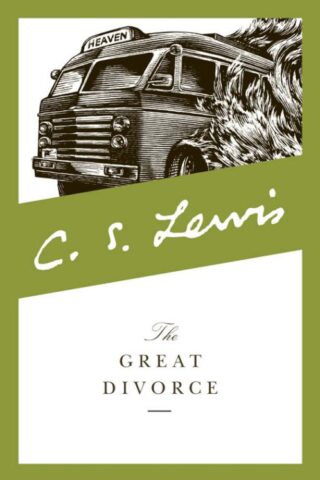
Great Divorce
Read moreC.S. Lewis takes us on a profound journey through both heaven and hell in this engaging allegorical tale. Using his extraordinary descriptive powers, Lewis introduces us to supernatural beings who will change the way we think about good and evil. In The Great Divorce C.S. Lewis again employs his formidable talent for fable and allegory. The writer, in a dream, finds himself in a bus which travels between Hell and Heaven. This is the starting point for an extraordinary meditation upon good and evil which takes issue with William Blake’s The Marriage of Heaven and Hell.
Reviews
There are no reviews yet.